How to Create a Travel Journal That You'll Actually Want to Keep
I have a shelf at home with seven abandoned travel journals. The first starts strong with three pages about arriving in Lisbon, then trails off into blank pages after day two. The second has a detailed Japan itinerary followed by a single sentence: "Tokyo is overwhelming." I used to think I was bad at journaling, but after years of experimentation, I realized the problem was my approach. I was trying to write a chronological diary of everything that happened, and that format is exhausting to maintain on the road. The journals I have actually kept use a completely different method. They are messy, personal, and specific. They contain ticket stubs, bad sketches, overheard conversations, and lists of things that went wrong. This guide is about building a creative travel journaling practice that works with your natural habits instead of against them. These travel journal ideas and practical advice on how to keep travel journal habits will help you build a lasting practice.
Choosing the Right Journal Format
The format matters more than the content, because the wrong format will stop you from writing before you start. I spent years buying beautiful leather-bound notebooks, convinced that a "proper" journal would motivate me. It never did. A pristine, expensive notebook made me feel like every entry needed to be polished. The journal I actually completed during a month in Morocco was a cheap Moleskine Cahier that cost $6, and I treated it like a disposable scrapbook. I glued in receipts, wrote in the margins, and spilled mint tea on at least four pages. It is my favorite travel journal, and also the ugliest one.
Consider your travel style. If you collect ephemera — menus, ticket stubs, business cards — choose a journal with thicker pages (at least 100gsm) that can handle glue and tape. The Leuchtturm1917 Medium (about $20) is popular because the paper quality is excellent and the dotted grid is versatile. If you prefer a minimalist approach, a simple Field Notes memo book ($13 for a pack of three) is compact enough to carry in your pocket.
Digital vs Physical Journaling
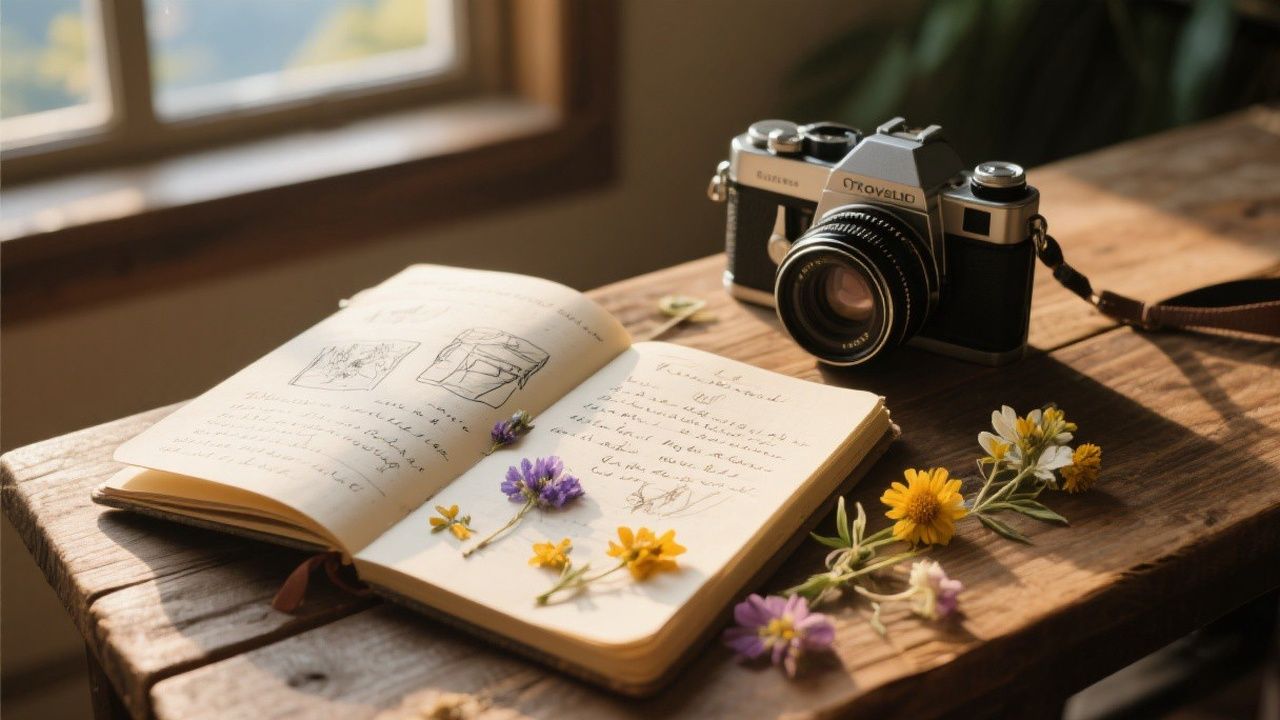
Digital journaling with apps like Day One or Journey is efficient, searchable, and backed up to the cloud. I use Day One for quick daily summaries when I am traveling through cities without time to sit with a physical notebook. Physical journaling, on the other hand, engages your brain differently. Research shows that handwriting activates deeper memory encoding than typing. When I write by hand, I remember details I would forget if I typed them. Physical journals also age beautifully. My Morocco journal has coffee stains, sand from the Sahara, and a pressed eucalyptus leaf. No digital app can replicate that tactile connection.
The best approach is a hybrid system. I use Day One for quick entries and photos, and a physical notebook for longer, more reflective writing and ephemera. When I get home, I combine both into a single photo book with printed journal entries.
Writing Prompts for Travelers
The biggest enemy of consistent journaling is the blank page. Specific prompts bypass this problem. "Describe the most surprising thing you saw today" forces you to notice details you might otherwise forget. In Hanoi, I wrote about a woman on a motorbike carrying six live chickens, balanced on one hand while texting with the other. "Write down a conversation you overheard but were not part of" captures the texture of a place. In Oaxaca, I overheard two women debating whether mole negro or mole coloradito was better, and their passion was so intense that I wrote down every word.
"What went wrong today, and what did you learn from it?" produces honest, entertaining entries. My entry from the day I missed my train in Budapest and ended up eating a terrible sandwich at a bus station is one of the funniest things I have ever written. "List five things you smelled today" is powerful because smell is the sense most closely linked to memory.
Daily Writing Habits

Consistency matters more than volume. A single paragraph written every day is more valuable than three pages on day one and nothing for the rest of the trip. Attach journaling to an existing daily habit. I write every evening while waiting for dinner to arrive at a restaurant. The food usually takes 15-20 minutes, which is exactly enough time to write a page. Do not try to write chronologically. Write about whatever is freshest in your mind. Set a minimum of three sentences per day. Most days you will write more, but the low threshold removes the psychological barrier.
Essential Tips to Keep in Mind
- Use washi tape or a glue stick to attach ticket stubs, receipts, menus, and business cards directly into your journal. These physical artifacts add texture that words alone cannot provide.
- Carry your journal with you everywhere. The best observations happen in transit — on buses, in waiting rooms, at airport gates.
- Do not edit as you write. Cross things out, use abbreviations, write in fragments. Perfectionism is the enemy of completion.
- Write the bad stuff. Missed flights, bad food, arguments with travel companions — these are the entries you will find most valuable years later.
- Date every entry and note the location. Future you will thank present you.
Frequently Asked Questions
What if I am not a good writer?
Travel journals are memory tools, not creative writing exercises. Your handwriting does not need to be neat and your prose does not need to be eloquent. A sentence like "the curry was so spicy I cried" is a perfect journal entry.
How do I journal when I am traveling with other people?
Write during natural gaps in the day — on the bus, while waiting for food, during your partner's shower. You can also invite your travel companion to contribute to the journal.
Should I share my travel journal online?
Keep at least one journal that is purely private. Writing for an audience changes what you record. A private journal frees you to be honest, petty, confused, and vulnerable in ways that a public blog does not allow.
Final Thoughts
The best travel journal is the one you actually write in. Not the most expensive one, not the most beautifully designed one — the one that fits into your bag, that you reach for without thinking, and that you fill with whatever comes to mind. Start simple, write badly, and let the habit build itself. The journal will become what it needs to be.